
main
Fixed vs. Floating Interest Rate: Which Should You Choose?
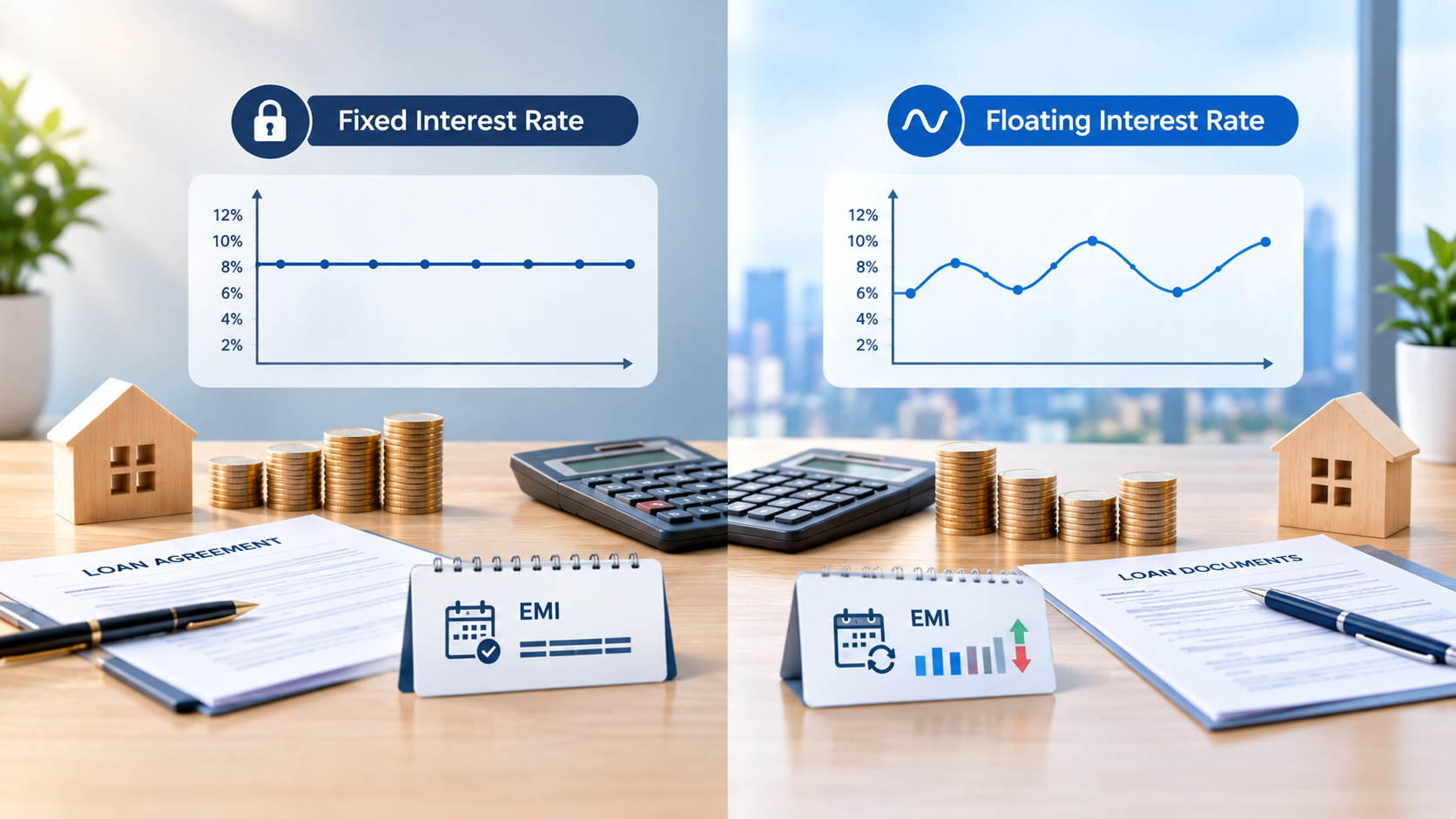
When applying for a home loan, personal loan, business loan, or another type of borrowing, the interest rate can significantly affect your monthly EMI and total repayment amount.
One of the important decisions borrowers may face is choosing between a fixed interest rate and a floating interest rate.
But what is the difference between fixed and floating interest rates? How does each option affect your EMI? And which one may suit your financial situation?
The right choice depends on factors such as your loan tenure, income stability, repayment capacity, expectations about interest rate movements, and the terms offered by the lender.
This guide explains fixed vs floating interest rates in simple terms so you can compare your options before taking a loan.
What Is a Fixed Interest Rate?
A fixed interest rate is an interest rate that remains unchanged for a specified period or, depending on the loan agreement, for the entire loan tenure.
Because the interest rate does not change during the fixed period, your interest-related EMI outgo is more predictable.
For example, if your loan has a fixed interest rate of 8.5% for the applicable fixed period, changes in market interest rates during that period may not change the contracted rate.
However, borrowers should always check the loan agreement carefully. Some products described as "fixed rate" may have a fixed rate only for a specific period and may include a reset clause afterward. The RBI also advises borrowers to understand whether a fixed-rate loan remains fixed for the entire tenure or only for part of it.
Advantages of a Fixed Interest Rate
A fixed rate can offer:
-
Predictable repayments: Your interest rate remains stable during the applicable fixed period.
-
Easier budgeting: A predictable EMI structure can make monthly financial planning easier.
-
Protection from rising rates: If market interest rates increase, your fixed rate may remain unchanged during the fixed period.
-
Greater repayment certainty: You can estimate your repayment obligations more easily.
Things to Consider
A fixed interest rate also has some limitations:
-
You may not benefit from falling market interest rates during the fixed period.
-
The initial fixed rate may be higher than a comparable floating rate.
-
Some loans may become floating after the fixed-rate period.
-
Switching or prepayment conditions can vary between lenders and loan products.
Always check the sanction letter, Key Facts Statement (KFS), and loan agreement for the exact rate structure, reset terms, charges, and other conditions.
What Is a Floating Interest Rate?
A floating interest rate can change during the loan tenure based on the benchmark or reference rate to which the loan is linked and the applicable spread and terms. These movements can affect your EMI and overall borrowing cost. Read our guide on RBI Interest Rate Changes in 2026 and How They Affect Your Loans & EMIs to understand how rate movements can affect your loan.
This means your borrowing cost can rise or fall as the relevant benchmark changes.
For eligible retail and MSME floating-rate loans, RBI regulations require banks to link such loans to specified external benchmarks. The RBI framework also provides for periodic resets, and the exact reset mechanism should form part of the loan terms.
How Does a Floating Rate Affect Your EMI?
If the applicable interest rate increases, your lender may adjust your EMI, loan tenure, or both, depending on the loan agreement and applicable rules.
If the interest rate decreases, your repayment cost may reduce, subject to how the lender applies the rate change.
For EMI-based floating-rate personal loans, RBI requires regulated lenders to communicate the possible impact of benchmark changes and provide information about the resulting changes in EMI and/or tenure.
Advantages of a Floating Interest Rate
A floating rate may offer:
-
Potential benefit when rates fall: Your applicable interest rate may decrease when the relevant benchmark falls.
-
Potentially lower initial rates: Depending on the lender and market conditions, the starting floating rate may be lower than a fixed option.
-
Flexibility with changing rates: Your loan pricing can adjust as the applicable benchmark changes.
Things to Consider
The main consideration is uncertainty.
If interest rates increase, your EMI or loan tenure may increase, depending on the lender's repayment structure.
Therefore, borrowers should make sure they have sufficient repayment capacity to manage possible changes in interest rates.
Fixed vs Floating Interest Rate: Key Differences
| Factor | Fixed Interest Rate | Floating Interest Rate |
|---|---|---|
| Interest rate | Remains fixed for the applicable period | Can change during the loan tenure |
| EMI predictability | Generally more predictable | Can change depending on the rate reset |
| Impact of rising rates | Less impact during the fixed period | Loan cost may increase |
| Impact of falling rates | May not benefit during the fixed period | May benefit when the applicable rate falls |
| Budget planning | Easier | Requires more flexibility |
| Interest rate risk | Lower for the fixed period | Higher because rates can change |
| Best suited for | Borrowers seeking repayment predictability | Borrowers comfortable with rate fluctuations |
The actual impact depends on the loan product, lender, benchmark, spread, reset frequency, and terms of the agreement.
Fixed vs Floating Home Loan: Which Is Better?
There is no single option that is right for every borrower.
The choice between a fixed and floating home loan interest rate should depend on your financial situation and the terms available to you.
A Fixed Rate May Suit You If:
-
You prefer predictable repayments.
-
You have a strict monthly budget.
-
You want protection against increasing interest rates during the fixed period.
-
You value repayment certainty more than the possibility of benefiting from falling rates.
A Floating Rate May Suit You If:
-
You can manage changes in your EMI or loan tenure.
-
You want the possibility of benefiting from falling interest rates.
-
You have sufficient financial flexibility.
-
You understand the benchmark and reset mechanism linked to your loan.
The decision should not be based only on the interest rate advertised by the lender. Look at the overall cost of borrowing, including processing fees, applicable charges, reset terms, repayment conditions, and other loan-related costs.
Fixed vs Floating Interest Rate: Example
Suppose you are considering a long-term loan and have two options:
Option A: Fixed Rate
The interest rate remains fixed for the agreed period. Your repayment structure is more predictable, making it easier to plan your monthly budget.
Option B: Floating Rate
The interest rate can change when the applicable benchmark changes. If rates fall, you may benefit from a lower rate. If rates rise, your EMI or repayment tenure may increase depending on the loan structure.
This is why comparing only the starting interest rate can be misleading.
A loan with a slightly lower initial rate may not necessarily result in a lower total repayment if rates change significantly over time.
What Should You Check Before Choosing an Interest Rate?
Before choosing between fixed and floating interest rates, consider these factors:
1. Loan Tenure
A longer loan tenure means you may be exposed to interest-rate changes for a longer period.
2. Monthly Income and Cash Flow
Consider whether your monthly budget can handle a potential increase in EMI.
3. Existing EMIs
If you already have multiple loans or credit commitments, leave enough room in your monthly budget for possible changes in borrowing costs.
4. Total Cost of the Loan
Don't compare interest rates alone. Review the loan's total cost, including processing fees and other applicable charges. If you already have a home loan and are considering a lower interest rate from another lender, you can also explore whether a home loan balance transfer could make sense. Read our guide on Home Loan Balance Transfer: When Should You Switch Your Loan? to understand the costs and factors to compare.
5. Reset Frequency
For floating-rate loans, understand how frequently the interest rate can reset and which benchmark is used.
6. Fixed-Rate Period
If a loan offers a fixed rate only for an initial period, find out what happens after that period.
7. Prepayment and Switching Conditions
Check whether you can switch between fixed and floating rates and what charges, if any, may apply.
For certain floating-rate loans, RBI rules provide specific protections and options around rate resets, including communication of changes and, in applicable EMI-based personal loans, options relating to EMI, tenure, switching to a fixed rate, or prepayment. The exact applicability depends on the loan type and lender.
Fixed or Floating Interest Rate: What Should You Choose?
Instead of asking "Which interest rate is better?", consider asking:
" Which interest rate structure is better suited to my financial situation? "
If predictable repayments are your priority, a fixed rate may provide greater certainty during the applicable fixed period.
If you have sufficient financial flexibility and are comfortable with changes in your repayment structure, a floating rate may be worth considering.
Before making a decision, compare the actual loan offers available to you and read the lender's terms carefully.
How Cito Wealth Can Help You Compare Loan Options
Choosing a loan is not only about finding a low interest rate. You also need to consider your income, credit profile, loan amount, tenure, repayment capacity, lender requirements, and the overall terms of the loan.
Cito Wealth helps borrowers explore loan options through a network of banks and financial institutions. As a Direct Selling Agent (DSA) and facilitator, Cito Wealth does not lend directly. It connects borrowers with partner lenders and assists with the loan process.
Whether you are exploring a home loan, personal loan, business loan, loan against property, or another financing option, Cito Wealth can help you understand available options and connect your profile with suitable lenders.
The final interest rate, loan approval, tenure, charges, and other terms are determined by the respective lender based on its policies and your eligibility.
Want to explore your loan options? Contact Cito Wealth to discuss your requirements and get guidance on the available financing options.
Final Thoughts
The difference between fixed and floating interest rates mainly comes down to predictability versus flexibility.
A fixed interest rate can provide more certainty during the fixed period, while a floating interest rate can move with the applicable benchmark and may result in changes to your repayment cost.
Before choosing, compare the interest rate, loan tenure, EMI, benchmark, reset terms, fees, prepayment conditions, and your own repayment capacity.
Most importantly, don't choose a loan based only on the advertised interest rate. Look at the complete loan structure and choose an option that fits your financial circumstances.
If you are comparing loan options and need help understanding the available choices, Cito Wealth can help you explore financing options through its lender network.
Disclaimer: Interest rates, loan approval, eligibility, fees, and terms are subject to the respective lender’s policies and assessment. This article is for general informational purposes only and should not be considered financial advice.